Philippines
A website for Airbnb hosts, built to win direct bookings
Keep Airbnb for reach, but give repeat guests a reason to book direct on a site you own, with fewer fees and your own brand.

Key takeaways
- Airbnb is useful for discovery, but a host-owned website gives repeat and referral guests a direct booking path outside the marketplace.
- Airbnb host fees are commonly discussed around 3 percent up to the mid-teens depending on the fee model, and guest fees can push total platform cost into double digits.
- A Philippine Airbnb host website typically costs around ₱45,000 to ₱250,000+ depending on property count, booking features, integrations, and content quality.
- Most hosts should complement Airbnb rather than quit it immediately, using the website for past guests, social traffic, referrals, and higher-intent inquiries.
- The most important website elements are strong photos, clear property details, availability or inquiry flow, local payment clarity, trust signals, and mobile speed.
Airbnb is reach, but your own website is the direct-booking asset you control
Airbnb is great for discovery, but a website for Airbnb hosts in the Philippines gives repeat, referral, and social-media guests a place to book direct with fewer platform fees and a clearer brand relationship.
Airbnb helps Filipino hosts get found by travelers who are already searching for stays in Metro Manila, Cebu, Siargao, Baguio, Tagaytay, Boracay, Palawan, and other local destinations. The trade-off is that the platform controls the ranking environment, much of the guest relationship, and the fee structure. Host service fees are commonly cited around 3 percent under some models and can reach the mid-teens depending on the fee model, while guest-facing fees can push the total platform cost into the double digits.
A host website is not a replacement for Airbnb on day one. A host website is a controlled booking channel where past guests, referrals, Instagram followers, TikTok viewers, corporate clients, balikbayan families, and long-stay inquiries can learn about the property and contact or book without starting inside an OTA marketplace.
| Channel | Airbnb only | Your own direct website |
|---|---|---|
| Reach | Strong built-in marketplace demand | Depends on your own SEO, referrals, ads, and repeat guests |
| Fees | Host fees commonly around 3 percent to mid-teens depending on model, plus guest fees | Payment gateway and operating costs, usually more predictable |
| Guest data | Limited relationship and platform-controlled messaging | You can collect inquiry details, preferences, and consent-based marketing data |
| Branding | Mostly standardized listing format | Full control of story, photos, room pages, FAQs, and policies |
| Repeat bookings | Guest may return to Airbnb and compare alternatives | Guest can return to your owned website and book directly |
| Risk | Ranking, policy, and competition changes affect visibility | You own the channel, but you must maintain traffic and trust |
The practical goal is not to fight Airbnb. The practical goal is to stop sending every guest relationship back to a marketplace after the first stay. For many hosts, the first direct bookings come from people who already know the property: past guests, friends of past guests, wedding guests, family groups, remote workers, and people who discover the stay on social media.
For hosts with villas, condos, beach houses, cabins, or boutique short-term rentals, a focused site is usually closer to a vacation rental website in the Philippines than a generic brochure site. If your main goal is to turn non-OTA traffic into bookings, a dedicated direct booking website for Philippine properties is the more accurate strategy.
The real cost of relying only on Airbnb
The real cost of relying only on Airbnb is not just the service fee, but the long-term dependence on a platform you do not control.
Airbnb fees matter because they affect both host payout and guest perception. Depending on the fee model and market setup, host service fees are often discussed in the low single digits under split-fee models and can move into the mid-teens under host-only models. Guest service fees can make the total amount paid by the guest feel meaningfully higher than the nightly rate they first saw.
The bigger issue is relationship ownership. When a guest books through Airbnb, the platform sits between the host and the guest. Messaging, reviews, dispute handling, reminders, and rebooking behavior are shaped by the platform experience. A satisfied guest may remember the platform more clearly than the host brand, especially when the property name is not easy to search later.
Ranking dependence is another hidden cost. A host can have good photos, good reviews, and competitive pricing, then still be affected by algorithm shifts, stronger new competitors, calendar gaps, cancellation rules, price changes, or changes in traveler demand. A direct website gives a host another surface area where Google, referrals, social links, QR codes, and email can point to the property directly.
Airbnb-only dependence tends to create several recurring problems:
- Past guests have no memorable direct place to return.
- Social media traffic is sent to a marketplace where alternatives are one tap away.
- The host cannot fully explain house rules, parking, neighborhood context, or special use cases.
- Longer-stay, event, corporate, or family inquiries are forced into a listing format.
- The host has limited control over remarketing and guest communication outside platform rules.
A direct site does not remove the need for good operations. Guests still care about cleanliness, accurate photos, fast replies, fair rules, and transparent pricing. A website simply gives those operational strengths a better place to be explained and converted into owned inquiries.
The best strategy is complement, not quit
The best strategy for most Airbnb hosts in the Philippines is to keep Airbnb for discovery and use your own website for repeat guests, referrals, social traffic, and higher-intent direct inquiries.
A direct-booking strategy works best when it is gradual. Airbnb can continue to fill dates, build review history, and introduce the property to new travelers. Your website can then capture demand from guests who already trust you or who want more detail than a marketplace listing can provide.
A host can start by adding the website to guest materials where platform rules allow after the booking relationship is established. Examples include a welcome card, printed house guide, QR code inside the unit, checkout message where compliant, Wi-Fi portal, or a post-stay email if the guest has opted in. The website should make the direct-booking reason clear without sounding suspicious: better repeat-guest communication, clearer property details, easier group planning, or occasional returning-guest offers.
The direct channel should also support your social media. Many Philippine hosts already get inquiries from Instagram, Facebook, TikTok, and local travel groups. Sending that traffic to an Airbnb listing can work, but it also puts your property beside competing listings. Sending it to your own site lets you show a full gallery, explain location, answer practical questions, and present a direct inquiry or booking path.
A simple direct-booking funnel can look like this:
- Airbnb, Instagram, Facebook, TikTok, or Google introduces the property.
- The guest visits the host website for photos, location context, rates, FAQs, and policies.
- The guest submits an inquiry, checks availability, or pays a reservation deposit.
- The host confirms details, collects guest information, and sends arrival instructions.
- After checkout, the host invites the guest to book direct next time.
The best direct-booking sites are honest about when Airbnb still helps. Marketplace bookings may remain useful for first-time guests who want platform protection, public reviews, and familiar checkout flows. Direct booking is strongest when the guest already trusts the property, the host communicates clearly, and the website answers the practical questions that prevent hesitation.
If you want help deciding whether direct booking is realistic for your property mix, you can book a free consultation and share your current listing, target guest type, and booking goals.
What an Airbnb host website needs to convert visitors
An Airbnb host website needs strong photos, clear availability or inquiry flow, trust signals, local payment options, house rules, and enough detail for a guest to choose confidently without returning to a marketplace.
A short-term-rental website is not just a digital flyer. A good host website reduces uncertainty. The visitor wants to know what the place looks like, where it is, how many people it fits, what is included, how to reserve, what payment methods are accepted, and whether the host is legitimate.
Property pages must answer practical guest questions
A property page should explain occupancy, bed setup, bathrooms, cooking facilities, parking, internet reliability, pet rules, pool or beach access, check-in process, security, and nearby landmarks. Philippine travelers often ask highly practical questions before paying: Is parking included? Can a sedan reach the road? Is there mobile signal? Is there a generator? Is corkage allowed? Are senior citizens comfortable with the stairs?
A page that answers these questions can reduce repetitive messages and improve lead quality. The goal is not to remove human conversation. The goal is to make each inquiry more informed before the guest contacts you.
Photos and layout matter more than decoration
For hospitality websites, images do much of the selling. A strong gallery should show bedrooms, bathrooms, kitchen, exterior, access road or entrance, view, work area, pool or common space, and real scale. Wide-angle photos can help, but misleading photography creates complaints later.
Modern development matters because guests browse on phones. A custom Next.js or React build can keep the site fast, structured, and easier to optimize than a slow template overloaded with plugins. For a broader view of build options, our guide on custom web development versus template builders explains where a premium build can matter.
Trust signals should be specific
Reviews, host identity, business details, social links, map context, and clear policies all help guests feel safe. If you quote reviews from public platforms, follow the platform's rules and avoid presenting anything misleading. If you are still building direct trust, start with clear contact details, a real property story, transparent policies, and consistent branding across your site and social accounts.
Want this done right, without the guesswork?
Book a free call and we'll map out exactly how we'd approach your project.
Direct booking, inquiry forms, and local payments
A host website can accept direct bookings through a booking engine, a structured inquiry form, or a hybrid flow with manual confirmation and local payment instructions.
The right booking flow depends on how complex your operations are. A single Airbnb condo in BGC or Cebu IT Park may not need a full booking engine at the start. A multi-property host, villa operator, or staycation brand with seasonal pricing may need availability calendars, blocked dates, deposits, automated emails, and clearer admin workflows.
| Booking flow | Best for | Advantages | Trade-offs |
|---|---|---|---|
| Inquiry form only | New direct-booking hosts and single-property owners | Simple, low-cost, easy to validate demand | Manual replies, no instant confirmation |
| Inquiry plus deposit instructions | Hosts who want commitment before blocking dates | Works with GCash, Maya, bank transfer, or payment links | Requires careful reconciliation and policies |
| Booking engine integration | Multi-property hosts or high-volume calendars | More automation, clearer availability, less manual work | Higher setup cost and operational complexity |
| Custom booking flow | Hosts with unique pricing, events, add-ons, or long stays | Tailored to actual business rules | Requires deeper planning and development |
Local payment behavior matters in the Philippines. Many guests are comfortable with GCash, Maya, bank transfer, and credit or debit card payment links. A website should explain whether a deposit is required, when the balance is due, what proof of payment is needed, and what happens if the guest cancels.
Payment clarity is a conversion feature. A guest who cannot understand the reservation process may return to Airbnb for perceived safety. A direct site should make the process feel professional: clear steps, confirmation messages, receipt or acknowledgment, cancellation policy, security deposit terms if any, and a named contact channel.
Direct booking also creates responsibility. Hosts should think about guest screening, data privacy, refund rules, receipts, local tax obligations, and written terms. A website can support these policies, but the business must be ready to operate them consistently.
If you are comparing owned booking channels against OTAs, our page on direct booking versus Booking.com and Agoda explains the trade-offs in fees, control, and guest behavior.
How much does a website for Airbnb hosts cost in the Philippines?
A website for Airbnb hosts in the Philippines typically costs around ₱45,000 to ₱250,000+ for a professionally built direct-booking or inquiry-focused site, depending on property count, booking features, design quality, integrations, and content needs.
Pricing varies because a one-property landing page is very different from a multi-property booking platform. A host with one condo, existing photos, and a simple inquiry process may only need a polished conversion site. A villa group with multiple units, seasonal pricing, GCash or Maya flows, calendar logic, email automation, and SEO content needs a larger build.
| Website type | Typical Philippine market range | Best fit | What is usually included |
|---|---|---|---|
| Basic host landing page | ₱45,000 to ₱90,000 | One property, manual inquiries | Mobile design, gallery, amenities, location section, contact form |
| Direct-booking starter site | ₱90,000 to ₱180,000 | One to three properties | Property pages, inquiry flow, policies, basic SEO, analytics, payment instructions |
| Booking-ready custom site | ₱180,000 to ₱350,000+ | Multi-property hosts or premium villas | Booking engine or custom flow, calendar logic, automated messages, stronger SEO structure |
| Ongoing care and improvements | ₱8,000 to ₱35,000+ per month | Hosts relying on the site for leads | Updates, monitoring, content improvements, conversion fixes, technical support |
These are general market ranges, not exact quotes from Studio Aurora. Some freelancers may quote lower, especially for template sites, while established agencies may quote higher for custom design, strategy, copywriting, integrations, and maintenance. USD equivalents can vary with exchange rates, but ₱45,000 to ₱250,000 is roughly about $800 to $4,400 at broad recent conversion levels.
Several cost drivers matter more than page count. Booking logic can become complex when nightly rates change by date, minimum stays vary by season, and discounts apply to weekly or monthly stays. Payment integration can also affect scope, especially if you need automated confirmation, partial payments, refund tracking, or reconciliation.
Content quality is another major cost factor. Many host sites underperform because the photos are weak, the copy is generic, or the FAQ ignores real guest objections. A good build should include practical content planning, not only page layouts.
For a deeper benchmark on Philippine website pricing, see our website design cost guide for the Philippines or our detailed article on custom website cost in 2026. If you want a scoped estimate for your property, you can tell us about your project and we can discuss what level of site makes sense.
SEO and content for Philippine Airbnb host websites
SEO for Airbnb host websites works best when the site targets specific destinations, property types, and guest use cases instead of generic terms like "staycation" alone.
A new host website will not instantly outrank major OTAs for broad travel keywords. A realistic SEO strategy targets searches that match the property closely. Examples include family villa in Tagaytay with pool, pet-friendly cabin in Baguio, beachfront house in Batangas for groups, work-from-anywhere condo in Cebu, or private resort near Manila for small events.
Local context helps because guests search with constraints. A visitor may care about drive time from Manila, distance to the airport, nearby restaurants, parking availability, access roads, mobile signal, or whether the property is safe for kids. These details are difficult to communicate fully on a marketplace listing, but they fit naturally on your own site.
A host website can also publish helpful pages that answer real trip-planning questions. A Siargao villa site might explain airport transfers, surf seasons, and generator availability. A Baguio cabin site might explain parking, fog season, nearby markets, and heater expectations. A Metro Manila condo site might explain proximity to event venues, hospitals, exam centers, or business districts.
The basic SEO checklist is short but important:
- Use destination-specific title tags, headings, and page copy.
- Create one strong page per property or property type.
- Add structured FAQs for policies, parking, payment, and check-in.
- Compress images and keep the mobile experience fast.
- Connect Google Search Console and track inquiries, not just visits.
SEO is not only technical. Google needs crawlable content, visitors need useful answers, and hosts need a conversion path. If your site is live but invisible, our guide on why your website does not show up on Google covers the usual causes.
Getting started with a direct-booking website
The best way to start is to define the property, guest type, booking flow, and direct-booking offer before designing the pages.
A host website project should begin with commercial clarity. The site should know whether it is selling a romantic stay, barkada trip, family reunion, remote-work base, corporate accommodation, event venue, or premium private villa. Each guest type has different questions, budget expectations, and trust concerns.
Before development starts, prepare your core assets. Gather your best photos, current rates, seasonal rules, cancellation policy, check-in process, parking details, exact location guidance, nearby landmarks, and frequently asked questions from Airbnb or social media. These inputs make the website more useful and reduce revisions later.
A practical launch plan usually includes three phases. First, build the core site with property pages, gallery, inquiry or booking flow, policy pages, analytics, and mobile performance. Second, connect the site to social profiles, guest materials, QR codes, Google Business Profile where applicable, and post-stay communication. Third, improve the site based on real inquiries, missed questions, conversion data, and seasonality.
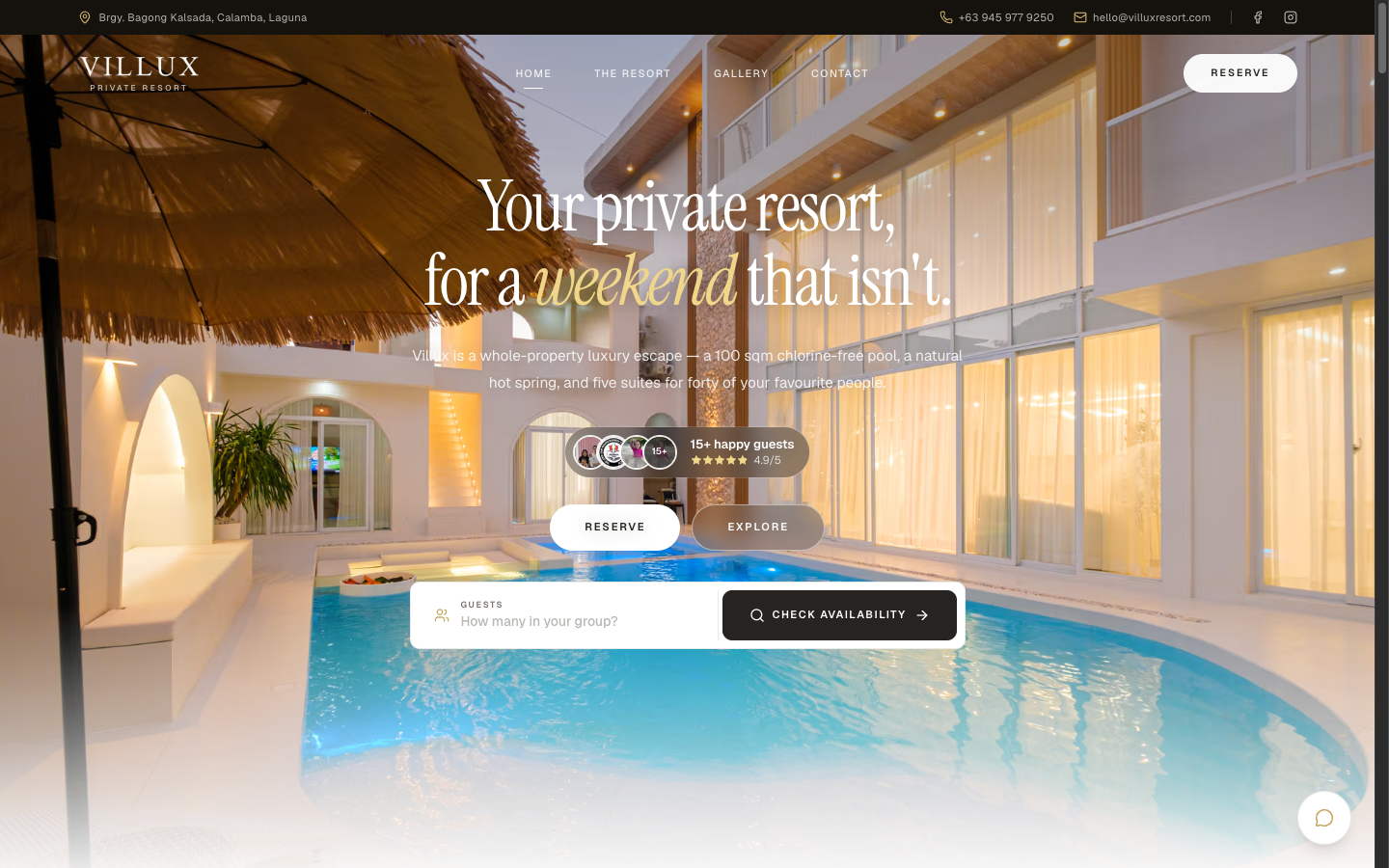
Studio Aurora builds custom modern websites on a Next.js and React stack for clients in the Philippines and worldwide. For Airbnb hosts, that means we focus on speed, mobile usability, structured content, conversion paths, and a site you can grow beyond a single listing. We do not need to replace every platform you use. We help create an owned channel that supports your existing booking mix.
If your property overlaps with hotels, resorts, or serviced stays, you may also find our pages on hotel website design in the Philippines and resort website design in the Philippines useful. To explore a direct-booking site for your Airbnb or short-term rental, book a free consultation and share your listing, location, and booking goals.
Selected work
Frequently asked questions
Do Airbnb hosts in the Philippines really need their own website?
Airbnb hosts do not always need a website at the start, but a website becomes useful when you want repeat guests, referrals, social media traffic, and long-stay inquiries to book or contact you directly instead of returning to a marketplace.
Should I stop using Airbnb if I build a direct-booking website?
Most hosts should not stop using Airbnb immediately. A safer strategy is to keep Airbnb for discovery while using your website for repeat guests, referrals, social traffic, and guests who already trust your property.
How much does a website for Airbnb hosts cost in the Philippines?
A professionally built website for Airbnb hosts in the Philippines typically ranges from about ₱45,000 to ₱250,000+, depending on whether it is a simple inquiry site, a multi-property site, or a booking-ready custom platform.
Can my website accept GCash or Maya payments?
Yes, a host website can explain or support local payment methods such as GCash, Maya, bank transfer, and card payment links. The exact setup depends on whether you want manual payment confirmation or a more automated booking and payment flow.
Can I use Airbnb reviews on my own website?
You should be careful when using Airbnb reviews outside the platform and follow the platform's current rules. Many hosts instead summarize trust signals, link to public profiles where appropriate, and collect direct guest feedback with permission.
What pages should an Airbnb host website include?
A strong host website usually includes a homepage, property page or pages, photo gallery, amenities, location details, house rules, rates or booking process, FAQs, contact or inquiry form, and privacy or booking policy information.
Will a direct-booking website rank on Google?
A direct-booking website can rank on Google, but it needs realistic local SEO targets, useful destination content, fast mobile performance, and time. It is usually easier to rank for specific property and destination searches than broad travel keywords.
What is better for a new host, instant booking or inquiry first?
Inquiry first is often better for new direct-booking hosts because it is simpler, cheaper, and easier to control manually. Instant booking becomes more useful when pricing, calendars, payment rules, and operations are mature enough to automate.
Explore more
Web Design Philippines
Studio Aurora designs and builds high-converting websites for businesses across the Philippines. Modern, fast, and engineered to turn visitors into customers, not just look pretty.
Web Design Manila
Manila moves fast and the competition is fierce. Studio Aurora builds websites that help Metro Manila businesses stand out, load instantly, and convert the traffic they're already paying for.
Web Design Cebu
Cebu's businesses are growing fast, in tourism, retail, services, and tech. Studio Aurora builds modern, high-converting websites that help Cebu brands compete locally and reach customers nationwide.
Web Design Agency Philippines
Freelancers vanish. Templates age. Studio Aurora is a web design agency that delivers senior design and development, a real process, and a site you actually own, for businesses across the Philippines.

Let's build something that works.
Tell us about your project and we'll map out exactly how we'd approach it. No pressure, no jargon.