Philippines
A web design agency Philippine businesses can rely on
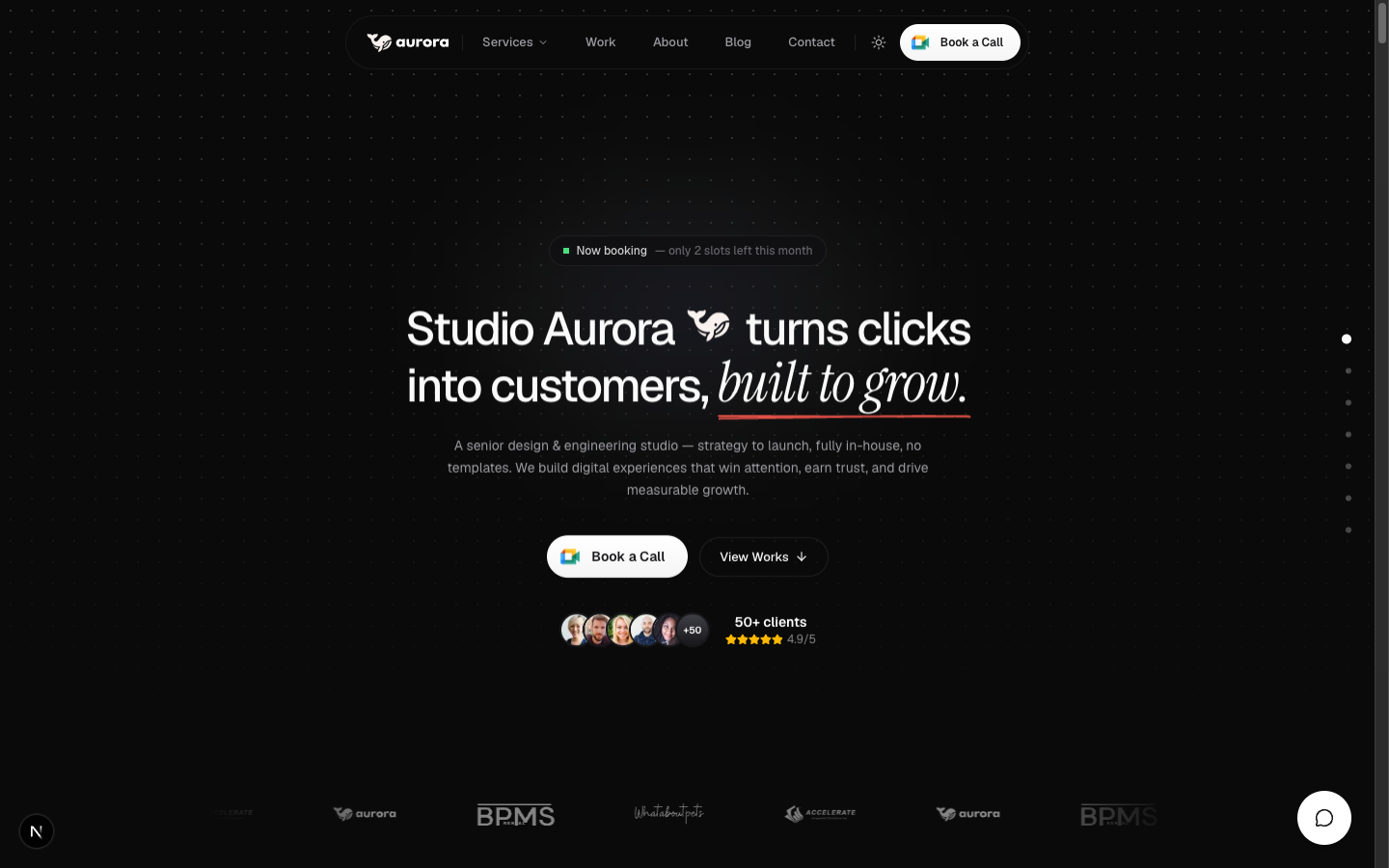
Freelancers vanish. Templates age. Studio Aurora is a web design agency that delivers senior design and development, a real process, and a site you actually own, for businesses across the Philippines.

Key takeaways
- Typical Philippine website options range from about ₱15,000 to ₱80,000 for cheap freelancers, ₱500 to ₱5,000 per month for DIY builders, and ₱120,000 to ₱600,000+ for professional agencies.
- A web design agency is usually best when the website is tied to revenue, trust, lead generation, ecommerce, or long-term marketing rather than being a temporary online brochure.
- The main agency advantage is not only design quality; it is process, accountability, technical planning, QA, launch support, and continuity after the site goes live.
- Businesses should clarify ownership of domain, hosting, source code, design files, CMS access, analytics, and content before signing any website agreement.
- Red flags include vague scopes, unclear ownership terms, guaranteed rankings, copied templates sold as custom work, and no support plan after launch.
What a web design agency in the Philippines actually does
A web design agency in the Philippines plans, designs, builds, launches, and supports a business website through a structured team process rather than a one-person handoff. A proper agency is not just someone who can make pages look nice; it should connect brand positioning, user experience, technical development, search visibility, conversion goals, and long-term ownership.
For many Philippine businesses, the real question is not whether a website can be made cheaply. The real question is whether the website will still be useful six months after launch, when the team needs edits, campaigns change, Google has indexed the site, and customers are deciding whether to inquire, book, or buy.
Studio Aurora is a remote-first web design and development studio serving businesses across the Philippines and abroad. We build custom modern websites on a Next.js and React stack, with a process designed for clarity, performance, maintainability, and conversion. If you are comparing options more broadly, our main web design Philippines page explains how custom websites fit different business types and budgets.
A web design agency should help you answer practical commercial questions before design begins. What should the site make easier for customers? Which pages need to rank or convert? What should be editable internally? Which integrations matter now, and which can wait? A good website project starts by reducing business uncertainty, not by choosing fonts.
The three hiring options: cheap freelancer, DIY template, or agency
In the Philippines, a basic website can cost around ₱15,000 to ₱80,000 with a cheap freelancer, around ₱500 to ₱5,000 per month with a DIY builder plus your own time, and around ₱120,000 to ₱600,000+ with a professional web design agency, depending on scope and complexity. These are general market ranges, not exact quotes, but they give a useful starting point for weighing cost against risk, quality, and long-term value.
Price matters, especially for small businesses in the Philippines, but the cheapest option is not always the lowest-cost option over time. A site that is slow, hard to edit, poorly structured for SEO, or abandoned after launch may require a rebuild sooner than expected. A more expensive project can be more economical if it reduces rework, supports marketing, and gives the business full ownership.
| Option | Typical Philippine market range | Best for | Main trade-off |
|---|---|---|---|
| Cheap freelancer | ₱15,000 to ₱80,000 | Very small brochure sites, experiments, early MVPs | Quality, availability, documentation, and continuity can vary widely |
| DIY builder or template | ₱500 to ₱5,000 per month, plus plugins, themes, and your time | Solo founders, temporary landing pages, simple validation | You provide strategy, writing, design judgment, setup, and maintenance |
| Professional agency | ₱120,000 to ₱600,000+ | Business-critical websites, service companies, ecommerce, lead generation | Higher upfront cost and more structured collaboration |
| Larger custom build | ₱600,000 to ₱1,500,000+ | Complex ecommerce, portals, custom dashboards, multi-market sites | Requires deeper discovery, technical planning, and phased delivery |
A cheap freelancer can be a good fit when the project is simple, the budget is fixed, and the website is not yet central to revenue. Many talented Filipino freelancers do good work, but solo availability is the risk. If one person handles strategy, copy, design, development, QA, deployment, and support, the project depends heavily on that person's capacity and working habits.
A DIY template can be practical when speed matters more than differentiation. Website builders can help businesses publish quickly, but they often shift the hardest decisions back to the owner. The platform provides tools, but it does not decide your messaging, information architecture, conversion flow, technical SEO, or content priorities.
An agency is usually the better fit when the website must represent the business seriously, generate qualified inquiries, support paid traffic, rank over time, or integrate with internal tools. A structured agency process costs more because it includes planning, design direction, engineering, testing, launch support, and accountability. For a deeper cost breakdown, see our guide to web design cost in the Philippines and our article on custom website pricing.
What you get from an agency that a solo freelancer may not provide
A web design agency gives you a repeatable project system, multiple skill sets, and continuity beyond one person's availability. The biggest difference is not only the number of people involved; it is the way decisions are documented, reviewed, tested, and handed over.
A freelancer may be excellent at one discipline, such as design or frontend development. A business website usually needs several disciplines to work together. A homepage has to position the company clearly, a service page has to answer buying objections, a contact flow has to reduce friction, and the codebase has to be stable enough for future edits.
| Area | Solo freelancer | Web design agency |
|---|---|---|
| Strategy | Often informal or based on brief | Discovery, goals, sitemap, user flows, conversion priorities |
| Design | Depends on individual skill | Design direction, UX patterns, responsive layouts, review cycles |
| Development | May rely on preferred tools or templates | Planned technical stack, code standards, QA, deployment workflow |
| Communication | Direct but capacity-dependent | Scheduled updates, documented decisions, defined responsibilities |
| Continuity | Risk if the person becomes unavailable | Shared project knowledge, handover assets, support options |
The agency advantage becomes clearer when a website needs to support marketing. A paid ads landing page, an SEO service page, an ecommerce collection page, and a corporate credibility page have different jobs. Treating every page as a visual layout leads to shallow websites that look acceptable but fail to guide users toward action.
Studio Aurora builds custom sites using a modern React and Next.js foundation because performance, maintainability, and content structure matter after launch. A custom build is not automatically better for every business, but it is often better when the website needs to feel tailored, load quickly, support structured content, and avoid the limits of generic templates. Our article on custom development versus template builders explains when that investment makes sense.
If you want to compare the agency route against hiring one person directly, our guide on how to find the right website developer without getting burned is a useful companion read.
Our process from first call to launch
A good agency process turns a vague website idea into a clear scope, a working product, and a launch plan with fewer surprises. The process should make the project easier to manage, not add bureaucracy for its own sake.
Studio Aurora typically starts with a consultation to understand the business model, audience, current site problems, marketing plans, and success criteria. A service business in Metro Manila may need stronger lead qualification and local trust signals. A Philippine ecommerce brand may need product discovery, checkout flow improvements, and analytics readiness. A B2B company serving international clients may need credibility, speed, and clearer technical messaging.
The discovery phase defines what the website must do. Discovery can include sitemap planning, page priorities, competitor review, content requirements, technical constraints, and conversion goals. A clear scope protects both sides because it separates must-have launch requirements from ideas that can be phased later.
A typical agency workflow looks like this:
- Discovery and scope definition, including goals, audience, pages, integrations, and constraints.
- Content structure and wireframing, so pages have a clear purpose before visual design.
- Visual design, responsive UI, and review cycles for key templates and page types.
- Development, CMS or content setup, analytics preparation, QA, and performance checks.
- Launch, handover, documentation, and optional ongoing support.
The design stage should be grounded in content, not decoration. A polished page with weak messaging will still underperform because users need clarity before they need visual effects. For most businesses, effective design means making the next step obvious, making proof easy to find, and removing friction from inquiry or purchase.
The development stage turns approved designs into a working website. On a Next.js and React stack, development involves component structure, responsive behavior, performance optimization, content models, deployment configuration, and testing across major devices. The technical goal is a site that feels fast, is maintainable, and does not trap the business in a messy setup.
If you already have a project in mind, you can book a free consultation and use the call to clarify scope, budget range, and whether an agency engagement is the right fit.
Want this done right, without the guesswork?
Book a free call and we'll map out exactly how we'd approach your project.
How a serious agency de-risks the project
A serious agency reduces website risk through transparent communication, documented ownership, maintainable implementation, and continuity after launch. The website industry has a trust problem because many businesses have experienced ghosting, unclear deliverables, locked accounts, or half-finished sites.
The first risk is communication risk. Businesses should not have to chase basic updates or guess what is happening with their own project. A healthy engagement defines communication channels, review points, decision owners, and expected response times before the work gets busy.
The second risk is ownership risk. A website can look complete while the business does not control the domain, hosting, repository, design files, analytics, or CMS access. Ownership must be clarified in plain language because the person who controls the accounts controls the future of the website.
The third risk is continuity risk. A site that only one person understands becomes fragile, even if the launch went well. Continuity improves when code is organized, credentials are handed over safely, content is structured, and the business has documentation for common edits.
A reliable agency engagement should make these points clear:
- Who owns the domain, hosting, codebase, design files, and content after payment and launch.
- What is included in the scope, what counts as a revision, and what is billed separately.
- How launch will be handled, including redirects, DNS, analytics, and backup planning.
- What support is available after launch and how urgent fixes are handled.
- Which parts of the site can be edited by your team without developer help.
Studio Aurora approaches risk reduction by making decisions explicit and keeping the project grounded in business outcomes. We do not claim that every project is simple, because good websites often require hard decisions about content, priorities, and trade-offs. We do believe clients should understand what is being built, why it matters, and how they will own it when it is live.
Red flags when hiring any web design agency in the Philippines
The biggest red flag when hiring a web design agency is vague promises without a clear scope, ownership terms, process, or evidence of how the work will be delivered. A beautiful sales pitch is not enough if the agency cannot explain what happens after you pay the deposit.
Be cautious when an agency guarantees rankings, leads, or revenue without controlling the factors that affect those outcomes. Website quality matters, but search performance and conversions also depend on offer strength, content depth, market demand, traffic sources, reviews, pricing, and follow-up speed. Honest agencies can explain how they improve the probability of better outcomes without fabricating certainty.
Be cautious when an agency cannot explain what platform or stack they use and why. Some businesses are fine on WordPress, Shopify, Webflow, or a builder, while others benefit from a custom stack. The concern is not the tool itself; the concern is when the tool is chosen for agency convenience rather than business fit.
Watch for these warning signs before signing:
- No written scope, timeline, payment schedule, or change request process.
- No clear answer on who owns the domain, hosting, source code, and design assets.
- Heavy reliance on copied templates while selling the project as fully custom.
- Refusal to discuss maintenance, security updates, backups, or launch responsibilities.
- Pressure tactics that push you to pay before basic questions are answered.
A good agency should be comfortable explaining trade-offs. Lower budgets may mean fewer custom page types, fewer integrations, or a simpler content system. Higher budgets should correspond to real work, not vague premium language. Our detailed guide to web design agency red flags gives a deeper checklist for evaluating vendors before you commit.
What is included in an agency website project, and what ownership means
A professional website project should include the agreed strategy, design, development, launch preparation, and handover assets needed to operate the site after it goes live. The exact inclusions vary by scope, but the client should never be left guessing which parts of the website they own or can edit.
For a custom business website, core deliverables often include a sitemap, key page designs, responsive development, CMS or content setup, contact forms, basic technical SEO setup, analytics preparation, deployment, and launch support. More advanced projects may include ecommerce functionality, custom integrations, multilingual structure, gated content, dashboards, or advanced tracking.
Ownership means the business has practical control over the assets and accounts needed to keep the site running. Domain access matters because the domain is the business address on the web. Hosting and deployment access matter because they control uptime and technical changes. Source code matters because it affects whether another developer can maintain the site later.
| Asset or access | Why it matters | What to clarify before signing |
|---|---|---|
| Domain | Controls the public web address | The domain should be registered under the business or transferable to it |
| Hosting or deployment | Controls where the site runs | The business should know the provider, billing model, and access level |
| Source code | Allows future development | Confirm whether code is handed over and under what payment conditions |
| Design files | Helps future design updates | Confirm whether editable files are included or only final exports |
| CMS access | Lets staff update content | Confirm which pages, collections, and fields are editable |
| Analytics and tracking | Measures traffic and conversions | Confirm account ownership and who receives admin access |
Studio Aurora's services are built around custom design and development, not renting clients a mystery website they cannot control. A site you own gives you leverage because future updates are not dependent on one vendor forever. Ownership also makes it easier to move hosting, add features, or bring in another specialist if your needs change.
Some businesses ask whether ownership means they should manage everything alone. Ownership does not mean isolation. Ownership means the business has control, while support means experts remain available when technical work, improvements, or troubleshooting are needed.
Ongoing support after launch, and when an agency is the right call
Ongoing support keeps a launched website useful by handling fixes, updates, improvements, performance checks, and new business requirements over time. Launch is an important milestone, but it is not the end of a commercial website's life.
Post-launch support can be light or active depending on the business. A brochure site may only need occasional content edits and technical checks. A lead generation site may need landing page iterations, conversion tracking reviews, and new service pages. An ecommerce site may need product page improvements, checkout optimization, campaign pages, and analytics troubleshooting.
A web design agency is the right call when the website is tied to revenue, reputation, hiring, investor confidence, franchise growth, or serious marketing spend. Agency-level work is also appropriate when internal staff need a reliable partner rather than another tool to manage. If your website is already attracting traffic but not converting, agency involvement can help identify whether the problem is messaging, UX, page speed, offer clarity, or measurement.
An agency may not be the right call if the business only needs a temporary one-page site, has no defined offer yet, or cannot provide feedback and content input. A DIY builder or lean freelancer engagement may be more sensible while the business is still validating the basics. The best vendor is the one that matches the stage, risk level, and commercial importance of the website.
For Philippine businesses comparing local options, location can matter less than process and responsiveness. A remote-first agency can serve Manila, Cebu, Davao, provincial businesses, OFWs building ventures, and international teams as long as communication is clear. If local market context is important to your search, you may also compare our pages for web design Manila and web design Cebu.
The best next step is to define what your website must achieve, what budget range is realistic, and what risks you want to avoid. If you want a custom website built with a senior process and clear ownership, tell us about your project and we will help you assess whether Studio Aurora is the right fit.
Selected work

Frequently asked questions
How much does a web design agency cost in the Philippines?
A professional web design agency in the Philippines commonly costs around ₱120,000 to ₱600,000+ for a custom business website, while larger or more complex builds can exceed ₱1,500,000. The final cost depends on pages, design depth, CMS needs, integrations, ecommerce functionality, content requirements, and support.
Is a web design agency better than hiring a freelancer?
A web design agency is usually better for business-critical websites because it provides a structured process, multiple skill sets, QA, documentation, launch support, and continuity. A freelancer can still be a good fit for small, simple, or budget-limited projects if the scope is clear and the business accepts the continuity risk.
When should I use a DIY website builder instead of an agency?
A DIY website builder can make sense for temporary landing pages, early business validation, personal projects, or very simple websites where budget is the main constraint. An agency is more appropriate when the website needs custom positioning, strong performance, conversion strategy, ownership clarity, or long-term maintainability.
What should be included in a professional website project?
A professional website project usually includes discovery, sitemap planning, content structure, responsive design, development, CMS or content setup, contact forms, basic technical SEO setup, analytics preparation, QA, launch support, and handover. More advanced projects may include ecommerce, integrations, multilingual content, dashboards, or custom workflows.
Who should own the website after launch?
The business should own or control the domain, hosting or deployment account, website content, analytics accounts, and agreed project assets after payment terms are met. Source code and design file ownership should be clarified in the contract before work starts.
How long does an agency website project usually take?
A custom business website often takes several weeks to a few months, depending on scope, content readiness, review speed, integrations, and complexity. A small marketing site may move faster, while ecommerce, multilingual, or custom application-style websites usually need more planning and testing.
Can a Philippine web design agency serve clients outside Metro Manila?
Yes. A remote-first web design agency can serve clients across the Philippines and internationally if the process, communication rhythm, and decision points are clear. Location is less important than responsiveness, documentation, technical capability, and mutual fit.
What are the biggest red flags when choosing a web design agency?
Major red flags include no written scope, unclear ownership terms, guaranteed SEO or revenue claims, pressure to pay before questions are answered, copied templates sold as custom work, and no plan for launch or maintenance. A reliable agency should explain deliverables, trade-offs, access, support, and responsibilities in plain language.
Explore more
Web Design Philippines
Studio Aurora designs and builds high-converting websites for businesses across the Philippines. Modern, fast, and engineered to turn visitors into customers, not just look pretty.
Web Design Manila
Manila moves fast and the competition is fierce. Studio Aurora builds websites that help Metro Manila businesses stand out, load instantly, and convert the traffic they're already paying for.
Web Design Cebu
Cebu's businesses are growing fast, in tourism, retail, services, and tech. Studio Aurora builds modern, high-converting websites that help Cebu brands compete locally and reach customers nationwide.
Web Design Cost Philippines
No vague “it depends.” Here's a straight breakdown of what a professional website costs in the Philippines, what drives the price, and where cheap sites quietly cost you more.

Let's build something that works.
Tell us about your project and we'll map out exactly how we'd approach it. No pressure, no jargon.